
Square Peppers Management (PTY) LTD Mobile Optometry Unit
The Square Pepper Optometry Unit visits companies onsite and the first action is to do a proper eye screening test with all employees in order to determine which employees need further testing. A full eye examination on the individuals that was identified with the screening process will be performed and all findings will be passed on the customer.
Visual Acuity Tests
Among the first tests performed in a comprehensive eye exam are visual acuity tests that measure the sharpness of your vision.
These usually are performed using a projected eye chart to measure your distance visual acuity and a small, hand-held acuity chart to measure your near vision.
In a visual acuity test, the person stands about 20 feet away from an eye chart, which contains letters of various sizes. If the person wears glasses or contacts, they are removed for the exam. One eye is covered and the person is asked to read the smallest line of letters possible.
Eye Exams for Children
As a parent/guardian/teacher, you may wonder whether your pre-schooler has a vision problem or when you should schedule your child's first eye exam. Eye exams for children are extremely important, because 5 to 10 percent of pre-schoolers and 25 percent of school-aged children have vision problems.* Early identification of a child's vision problem can be crucial because children often are more responsive to treatment when problems are diagnosed early. Infants should have their first comprehensive eye exam at 6 months of age. Children then should have additional eye exams at age 3, and just before they enter the first grade — at about age 5 or 6.
For school-aged children, an eye exam every two years if no vision correction is required. Children who need eyeglasses or contact lenses should be examined annually or as recommended by their optometrist or ophthalmologist.
Early eye exams also are important because children need the following basic skills related to good eyesight for learning:
• Near vision
• Distance vision
• Binocular (two eyes) coordination
• Eye movement skills
• Focusing skills
• Peripheral awareness (The edges of your visual field)
• Hand-eye coordination
EXAMPLES OF WHAT AN EYE TESTING CHART WOULD LOOK LIKE IF THE CHILD CAN NOT READ YET
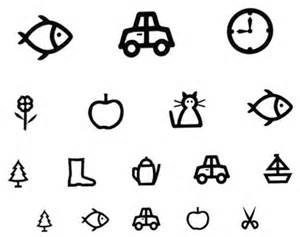
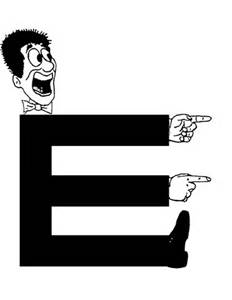
Appropriate vision testing at an early age is vital to insure your child has the visual skills he or she needs to perform well in school.
A child who is unable to see print or view a blackboard can become easily frustrated, leading to poor academic performance. Some vision problems, such as lazy eye, are best treated if they are detected and corrected as early as possible while the child's vision system is still developing.